
Rowing the Atlantic, Alone
Interview conducted and blog written by Jasmine Borg, Health Psychologist & Sport Psychology Practitioner
MOVE, The Sport & Exercise Medicine Centre, March 2026.
Steve Chetcuti became the first Maltese person to row solo across the Atlantic Ocean. This is what he learned about the human mind along the way.
"There is no way on earth I would have given up. Even if I lost a limb, I would have kept on going.”
Imagine waking up in the middle of the night, not in your bed, but on a tiny rowing boat in the middle of the Atlantic Ocean. There is nothing around you: no land, no other boats, no people. Just the big open dark ocean, a sky full of stars, and a very long way to go. Now imagine that this is your everyday reality for over 50 days.
That is exactly what Steve Chetcuti did. Steve is the first Maltese athlete to row solo across the Atlantic Ocean, completing the crossing at the start of 2026, and he has actually done an ocean row twice, having previously completed a team crossing in 2021. At MOVE, we had the privilege of sitting down with him for a frank and fascinating conversation about his journey, and about what it truly means to push the human mind to its limits.
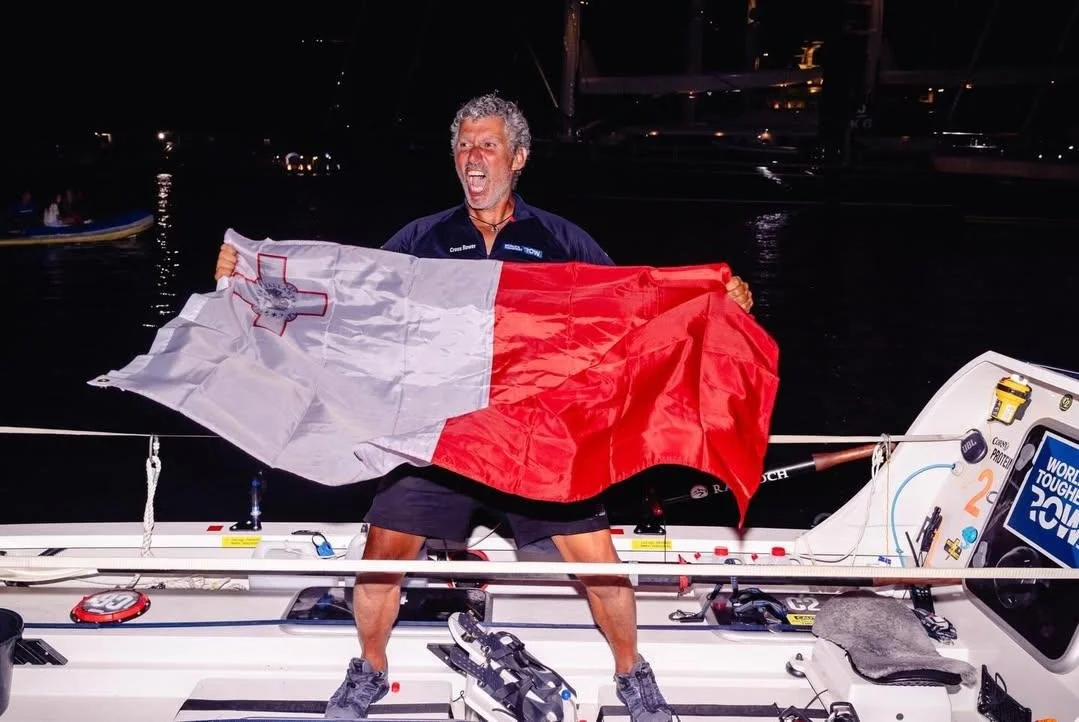
Photo: Instagram/@worlds.toughest.row
5000 km: Solo Atlantic Crossing
54 Days: At Sea Alone
19 kg: Weight Lost At Sea
From a Bathtub Around Malta to the Open Atlantic
Steve's story did not begin with a grand plan. As a teenager growing up in Malta, he and a friend had dreamed of paddling around the island in a bathtub to raise money for charity. "Of course, it never happened," he laughs. But that spark of adventure never quite went out.
Years later, living in Switzerland, Steve switched on Swiss TV one evening, hoping to practise his German. He stumbled upon a documentary about four men who had rowed across the Atlantic in 2017. His immediate reaction? "I could do that."
Those four words changed everything. He began watching every video and reading every article he could find on ocean rowing. He discovered that fewer than 2,000 people in modern history have ever rowed across an ocean, a group so small it represents a tiny fraction of the world's population. Of those, only around 200 have done it more than once. Steve has now done it twice.
There was also a deeply personal motivation. In 2018, Steve's brother passed away from a brain tumour. "I was always thinking: what can I do to honour his memory?" The idea of doing something extraordinary, something that truly pushed him to his absolute limits, felt like the right kind of tribute.
The Mind on the Ocean: Boredom, Routine & Mental Tricks
When most people imagine an Atlantic crossing, they picture dramatic storms and towering waves. And yes, those exist. But Steve is quick to point out that the greatest challenge is something far more ordinary: boredom.
"It's extremely boring," he admits. "You row for 12 hours, and the scenery just does not change. The sea remains the same. The sky remains the same." With no landmarks, no passing buildings, no changing landscape, just the endless blue, the mind is left entirely to its own devices. And as Steve discovered, an idle mind in the middle of the ocean can quickly become your worst enemy.
Why Boredom Is a Hidden Threat - Sport Psychology Perspective
From a psychological standpoint, boredom is not just uncomfortable; it can be genuinely dangerous for endurance athletes. When the brain has nothing to engage with, it tends to drift toward negative thinking, a pattern rooted in our evolutionary wiring. Steve's instinct to actively manage his thoughts is a textbook example of what sport psychologists call cognitive self-regulation.
Steve's solution was to turn his mind into a project manager. Before each crossing, he deliberately saved certain problems to "think through" at sea: home renovation plans, creative projects, decisions he had been putting off. "I planned things in my head," he says with a grin. "We actually have a nice new terrace that came as a direct result of my first row. I planned it all in my mind." Audiobooks were another lifeline, especially long ones. Angela Merkel's biography, a 24-hour listen, kept him company across the waves.
He also played clever tricks with time. As the boat crossed multiple time zones, the natural sunrise grew earlier and earlier. Rather than fight it, Steve kept his internal clock fixed. "I always left the time the same at seven-thirty on the screen, so in my mind, I'd say, 'Oh, it's seven-thirty, I can get up.' But in actual fact, I'd be going out at five in the morning." Small deceptions, but powerful ones.
Breaking It Down: The Power of Small Goals
Fifty-four days is an almost incomprehensible length of time to be alone on the ocean. So Steve never thought about 54 days. He thought about getting to Christmas. Then New Year's Day. Then his daughter Mia's birthday on the fourth of January. Then his daughter Kim's birthday on the twelfth.
"It wasn't 54 days. It was always small, small chunks," he explains. "Let me get to Christmas. Let me get to New Year's. And then it's not so big."
“In the first row, I really hit rock bottom, and then found out that there was actually more space under rock bottom. When people think it's bad, it could be much worse.” - Steve Chetcuti
This is a strategy sport psychologists know well: breaking an overwhelming challenge into manageable stages. Each milestone becomes its own finish line, its own small victory. The Atlantic becomes a series of birthdays, holidays, and sunrises, each one a reason to keep the oars moving.
When the Lows Hit Hard: Emotion, Tears & Bouncing Back
Steve does not pretend it was all grit and determination. Around day 37 or 38, somewhere around the 21st of January, he experienced what he calls a full mental breakdown. The estimated arrival date, which had been sitting at "about 10 days away" for almost a week, simply refused to get closer, no matter how hard he rowed. "That was what really tripped me up," he recalls. "Not the fact that I had 15 days left, but the fact that you row for 12 hours and it's still 10 days away.”
In those moments, he did not try to suppress what he was feeling. "I would stop rowing for five minutes, cry, drink some water, probably have some sweets, and complain a little, as we Maltese know how to do very well." Then he would pick up the oars and keep going.
The Emotional Mind, the Rational Mind, and the Wise Mind - Sport Psychology Perspective
What Steve describes maps beautifully onto a concept from Dialectical Behaviour Therapy (DBT), a well-established psychological framework developed by Dr. Marsha Linehan. DBT describes three states of mind we all move between. The emotional mind is driven by feelings, the rational mind is driven by logic and facts, and the wise mind sits at the intersection of both. It is the part of us that can acknowledge how we feel while still choosing to act in a way that serves our deeper goals.
Steve's approach at sea is a remarkable real-world example of the wise mind in action. He allowed himself to cry, to feel the weight of what he was going through, and then made the deliberate choice to pick up the oars again. He was not suppressing his emotions, nor was he being ruled by them. That balance is something DBT practitioners work hard to help people develop, and it is a skill that proves just as vital on the ocean as it does in everyday life.
His deepest motivation in those dark moments? His children. "I don't want to let them down," he says simply. "Are you going to give up? Really? Are you going to give them that message?" Purpose, something bigger than the individual, is one of the most consistent psychological anchors we see in ultra-endurance athletes.
Loneliness: The Real Reason for the Row
Beneath the feat of physical endurance, there was a cause close to Steve's heart: raising awareness about loneliness. When he and his wife moved to Switzerland, they found, as many expats and immigrants do, that making genuine friendships was surprisingly difficult. "You go to work, you do your work, you have coffee, and then they go home and you go home." Without a social network, without the easy warmth of Maltese community life, Steve experienced real loneliness firsthand.
"Loneliness is a killer, not figuratively but literally," he says. "If you're lonely, you fall into a little bit of a dark world, and the more lonely you are, the worse it gets." He references a study suggesting that around half of people in Malta report feeling lonely, one in every two people.
Steve experienced this himself, even describing periods of burnout and depression, years of pushing through without acknowledging the weight of what he was carrying. He is frank about the fact that, growing up male in his generation, you simply did not talk about these things. "You keep your mouth shut and keep on going." Part of what drove him to take on the Atlantic was a desire to use his platform to say: that is not the only way.
“You can be alone in a group of people. The worst loneliness is when you're surrounded by people and still feel invisible. We don't talk about it enough.” - Steve Chetcuti
He tells a lovely story about a neighbour called Mary, back in Malta. He would stop by just to say hello, and she would talk for 40 minutes about every ailment she had. "But maybe she was lonely. And I'd realise that even I would get so excited to be in a social situation." That human spark, that need for genuine connection, is something no ocean can extinguish.
Lessons for Your Own Atlantic
Not many of us will ever row an ocean. But most of us will, at some point, face a challenge that feels just as vast and just as relentless: a health battle, a career setback, a period of grief or isolation. Steve's story is, at its core, a human one. And the lessons he drew from the Atlantic apply on dry land too.
Steve's Six Lessons from the Ocean
Break it into chunks. Never look at the whole 54 days. Find your next birthday, your next Christmas, your next small finish line and aim for that.
Plan your thinking. When boredom or dark thoughts creep in, having something purposeful to think about makes all the difference. Give your mind a project.
Let yourself feel it, then keep going. Crying is not weakness; it is a release valve. Feel it, acknowledge it, then pick up the oars.
Prepare for the "what ifs." Steve lost 19 kilograms partly because he had not properly planned for what he would eat when he could not cook. Think ahead. Have contingency plans.
Ask for help when you need it. Even solo, Steve called his wife and his race organisers on bad days. You do not need to go it entirely alone, even when you are technically alone.
Say hello to Mary. Reach out. You never know who in your life is quietly struggling in loneliness. A small gesture can mean more than you think.
The Shore Is Always Out There
When Steve finally saw land after weeks of open ocean, he describes it as one of the most exhilarating moments of his life. He had been told he would spot it at around eight nautical miles out. He was 15 miles away when he stood up to grab something from the cabin, turned around and there it was.
"Is that land, or is it an optical illusion?" he asked himself. It was land. After 54 days of rowing, it was land.
That moment, the shore appearing after what feels like an impossible journey, is something we can all hold onto. However long the ocean stretches in front of you, the shore is always out there. You just have to keep rowing.
At MOVE, we are passionate about the connection between physical performance, mental health, and human resilience. Steve's story is a remarkable reminder of what the human mind is capable of and of why looking after it matters just as much as looking after the body.
If you are experiencing loneliness, low mood, or would like support with your mental performance and wellbeing, our team at MOVE is here to help.
