
Building Strong Nutrition Foundations
By Diana Azzopardi, Nutritionist
Fibre maxxing… intermittent fasting… low carb… a daily dose of creatine… the list goes on. The internet is buzzing with all sorts of wellness trends, and you may be wondering – should I be doing any of these? As with everything related to nutrition, the answer is – it depends.
“It depends” is the answer that separates a qualified nutrition professional from everyone else. We avoid onesizefitsall advice and aim to understand your personal circumstances before recommending any approach.
Whether a specific way of eating is appropriate for you depends on several factors, including your health status, your health and fitness goals, your physical activity level and your current diet. But before doing anything else, focus on building strong foundations because they support your long-term health and well-being far more than any wellness trend.
What Does Building Strong Nutrition Foundations Mean?
It means doing certain things consistently over a long period of time. As a nutritionist, I am least interested in what you do occasionally; it is what you do every day that matters.
For example:
Are you eating several portions of colourful veggies?
Soes your carb intake come mainly from wholegrains (e.g., brown bread and pasta, brown rice, oats) and starchy vegetables (e.g., potatoes with the skin on), known as “complex” carbohydrates?
Are you eating enough fibre-rich foods, such as beans and lentils, nuts and seeds, fruit and berries?
Is your protein intake a good balance of animal proteins (e.g., meat, eggs and dairy), fish and plant proteins (e.g., legumes, tofu, edamame, nuts and seeds)?
Is your main source of healthy fats oily fish (e.g., salmon, mackerel, sardines), olive oil, avocado, nuts and seeds?
Are you drinking enough water?
Apart from specific foods, having strong nutrition foundations also means eating regularly and in sufficient amounts for your specific needs.
How to build strong nutrition foundations?
To become consistent with your eating habits, they need to fit inside your real life – your personal and your family’s routine, work commitments, financial situation, available free time, interest in cooking and ability to do so, and so on. The most perfect meal plan will be unsustainable if it disregards your personal circumstances and will fall apart the moment “life happens” – you experience a busy week at work, kids get sick, and/or you generally feel low on energy. This is not to say that you should not plan anything. Planning is still important!
The key is planning for the worst, not your best week – assuming that on some days you will be nailing your “todo” list, whereas on others all you will be capable of is reheating last night’s leftovers.
This is where some food prep techniques may be useful, e.g., batchcooking on the weekend and storing the prepared food in the fridge or freezer for the upcoming week, cooking once and eating twice (i.e. cooking double the amount of food and splitting it between two meals), or simply chopping up some veggies for the next 2–3 dinners because you know it will be really helpful to have them ready to make dinner prep quicker. Experiment with these techniques to find out which works best for you.
There are a few tricks that can make eating healthily the easier choice, such as keeping fruit visible in a bowl on the countertop, keeping a water jug next to the kettle, toaster or in another frequently visited spot, and making sure to stock certain ingredients that can be thrown together to make a balanced meal (e.g., a jar of olives, canned beans, tinned fish, frozen veggies and berries, a jar of nut butter, etc.).
Having a few very easy and quick recipes on hand is also useful for those days when you find yourself particularly busy. Even a toast can be turned into a nutritiously balanced meal with the right “addons”, e.g. canned fish or chickpeas, some avocado and a handful of rucola.
For a meal to be balanced, it does not need to be complicated. Your meals can be as simple or as elaborate as you want them to be, and what is possible for you in the given situation. Follow this simple formula to build a balanced plate: ¼ complex carbohydrates, ¼ protein and ½ colourful vegetables and fruit, as illustrated in the image below:
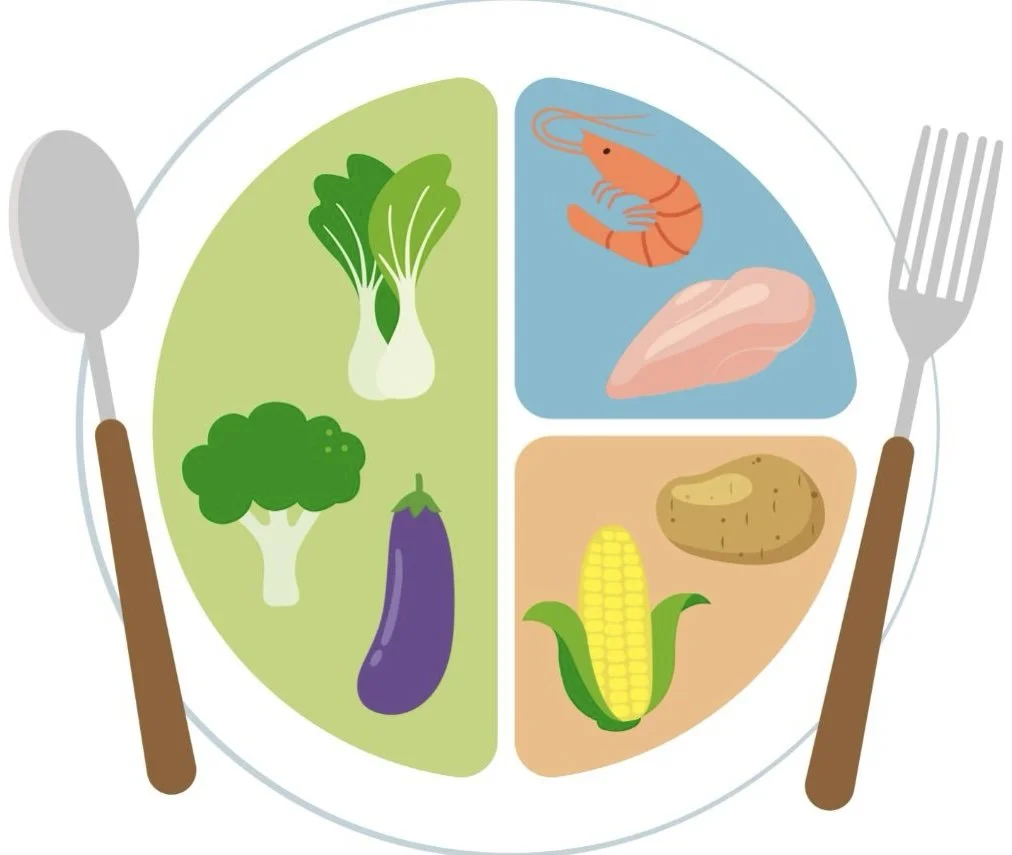
Finally, it is important to remember that healthy eating does not mean eating perfectly every single day. Some days may look more balanced than others, and there is nothing wrong with that. As noted before, strong foundations are built with consistent actions over a long period of time, not single meals. Be kind to yourself and do your best in your current situation.
