
Men’s Nutrition
By Diana Azzopardi, State Registered Nutritionist
Following Father's Day weekend, this feels like a good time to talk specifically about men’s nutrition. Statistics tell us that men are more likely than women to live with excess body fat and high blood pressure or cholesterol [1] - all risk factors for chronic health conditions, such as cardiovascular disease, which can reduce both quality of life and lifespan. At the same time, men are less likely to look for health information or use preventive care services [2].
A healthy diet forms part of the foundation for long-term health. If you feel that your diet needs some improvement, but it sounds like too much work or too restrictive, please read on. My aim is to show you that eating healthily does not need to be complicated and can still be flexible. Just as it was for my client Michael.
But first, a bit of men’s health context. While dietary guidelines for men and women are largely the same, with minor differences due to body size and energy expenditure, there are a few social and behavioural differences between genders which may make sticking to a healthy dietary pattern more challenging for some men. Men are more likely than women to engage in risk behaviours, such as excessive drinking, smoking and poor diet [3]. On the other hand, men are often praised for certain “masculine” behaviours, such as extreme exercise regimens and “clean” (read: very restrictive) diets which in some cases lead to disordered eating patterns and obsession with body shape and body image. Yet despite these challenges, it is often seen as more socially acceptable for women than men to seek treatment and discuss symptoms [2] – a sad reality that needs to change.
Most men reach their peak height and bone density somewhere in their 20s, followed by a few years of relative stability. Just like in women, men’s hormone levels naturally begin to change from their 30s onwards, including testosterone, the main male sex hormone involved in muscle, bone, sex drive and sperm production. Certain lifestyle habits, such as poor sleep, chronic stress, high alcohol intake, low zinc levels (which may result from heavy drinking) and weight gain can accelerate the decrease in testosterone. Lower testosterone levels may contribute to symptoms such as fatigue, lower libido, lower mood and reduced muscle recovery. The good news is that lifestyle changes, such as managing weight with a healthy diet and regular exercise may have a positive effect on the levels of this hormone. For example, studies show that in men with overweight and/or obesity, weight loss and increased physical activity substantially increased testosterone levels [4,5].
If you are wondering where to start with eating more healthily, here are some of the tips I often recommend to my clients:
If your kitchen confidence is low, learn a few simple ways to prepare food. Healthy eating does not need to be complicated or cooked entirely from scratch. Pantry staples such as wraps, a can of tuna, tomato paste and olives can make a delicious lunch; a tub of plain Greek yoghurt, low sugar cereal or granola and a handful of berries in the morning is a great way to start your day. A baked sweet potato with some deli chicken and steamed frozen veggies can make a satisfying dinner.
Focus on what you can add to your meals, not remove or avoid: a handful of rucola on your pizza, a sprinkle of pumpkin seeds on your omelette or a few cherry tomatoes to accompany your sandwich are all great ways to increase your meal’s nutritional content.
Healthy swaps. There is no need to cut out chocolate and other treats entirely; it is all about balance. However, if you find yourself relying on sweets for snacks, opt for healthier options, such as a handful of nuts and some fruit or some wholegrain crackers and a dip (store-bought is fine; just choose the option lowest in salt and saturated fat).
Explore plant-based protein sources. While there is a place for both animal and plant foods in a healthy balanced diet, we now know that increasing plant-based foods is good not only for the planet, but also for our long-term health. In practice, it may mean swapping meat for baked beans in a jacket potato or adding lentils to a Bolognese sauce.
Limit alcohol. From the health perspective, there is no safe limit for alcohol; however, some people find that a drink in a social situation can be stress-reducing and relaxing. If you notice that your health is suffering or you feel worse the following day, reduce your alcohol intake by switching to zero or low alcohol drinks.
Watch portion sizes. If you notice that your weight is gradually increasing over time, check if your portions align with your energy needs.
To determine portion sizes appropriate for you, use your hands for reference:
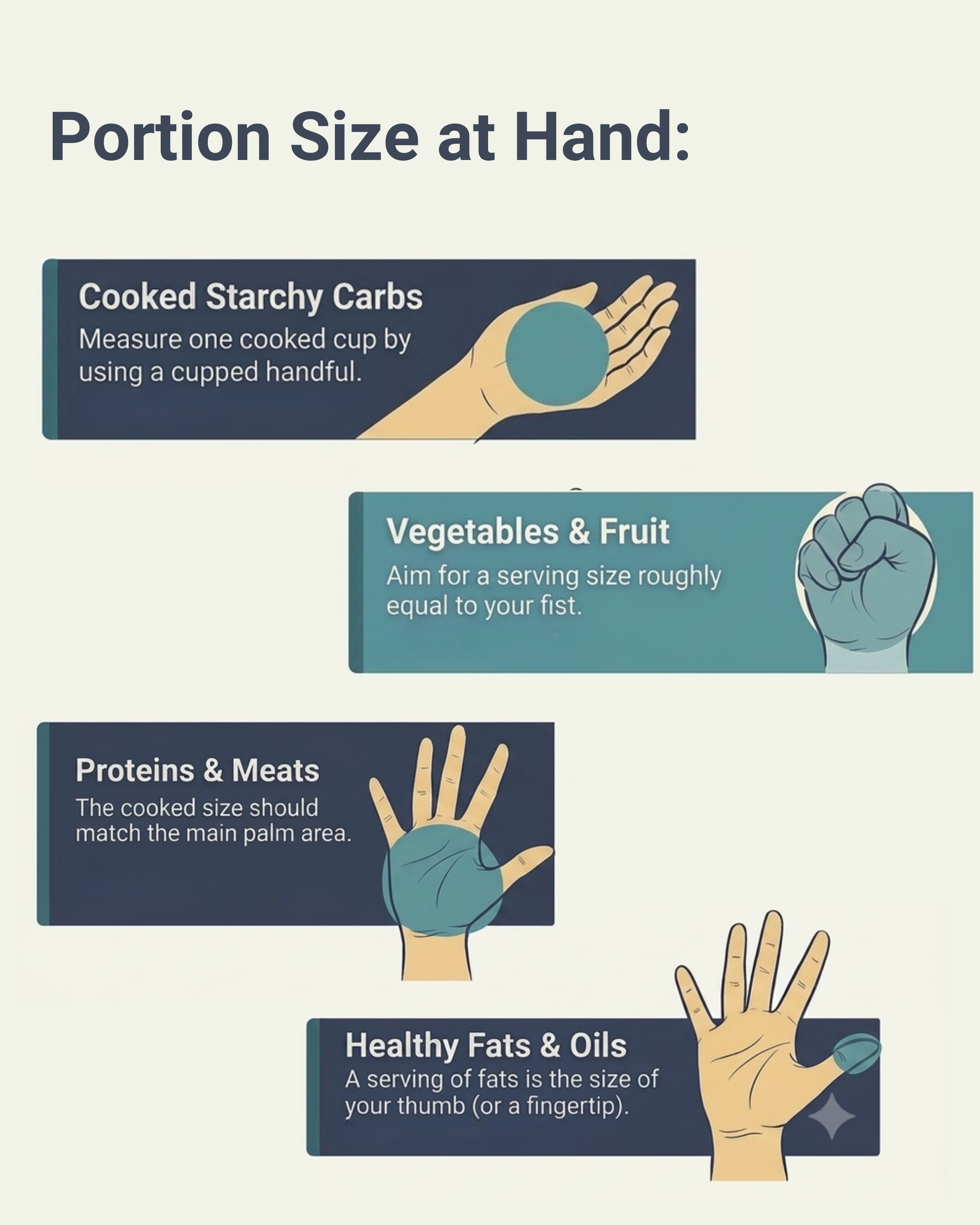
Source: Nestle Professional
But now back to Michael. In his late 40s, Michael was living with excess weight, raised blood pressure and high cholesterol. After reviewing his routine diet, I suggested a few simple tweaks to his meals to lower salt and saturated fat and to increase his vegetable intake. For example, swapping processed ham for roasted chicken, adding mushrooms to pizza, adding beans to chilli and using plant-based cooking cream instead of double cream. Over time, these changes helped Michael lose weight and improve his cardiometabolic markers, without feeling that he was being deprived of the foods he enjoyed. This is what Michael himself said a few months after adopting the dietary changes:
“This low-impact approach worked for me as a middle-aged low-intensity guy. A few months in, I feel that very little has changed while at the same time my diet is now more complete and putting me in actual calorie deficit for the first time in a couple of decades. I feel confident that I can sustain this new regime in the long term.”
Michael is a good example that it is possible to eat healthily in a flexible and sustainable way. I hope that his story has encouraged you to review your own dietary habits and make a few tweaks where they might be helpful.
References
HBSC, 2022. WHO European Regional Obesity Report Reveals Extent of Health Challenge Across Europe (online). Available at: https://www.hbsc.org/who-european-regional-obesity- report-reveals-extent-of-health-challenge-across-europe/ (June 21, 2026).
European Institute for Gender Equality, 2021. Women are More Likely to Have Health Limitations over Their Lifetime (online). Available at: https://eige.europa.eu/publications- resources/toolkits-guides/gender-equality-index-2021-report/women-are-more-likely-have- health-limitations-over-their-lifetime?language_content_entity=en (June 21, 2026).
Feraco A., Armani A., Amoah I., Guseva E., Camajani E., Gorini S., Strollo R., Padua E., Caprio M. and Lombardo M., 2024. Assessing Gender Differences in Food Preferences and Physical Activity: A Population-based Survey. Frontiers in Nutrition, 11, pp.1348456. doi: 10.3389/fnut.2024.1348456
Ken-Dror G., Fluck D., Fry C.H., Han T.S., 2024. Meta-analysis and Construction af Simple- to-use Nomograms for Approximating Testosterone Levels Gained from Weight Loss in Obese Men. Andrology, 12, pp.297-315. https://doi.org/10.1111/andr.13484
Kumagai H., Zempo-Miyaki A., Yoshikawa T., Tsujimoto T., Tanaka K., Maeda S., 2016. Increased Physical Activity Has a Greater Effect than Reduced Energy Intake on Lifestyle Modification-induced Increases in Testosterone. Journal of Clinical Biochemistry and Nutrition, 58(1), pp.84-9. doi: 10.3164/jcbn.15-48
