
Nutrition And Mental Health
By Diana Azzopardi, Nutritionist
Mental health disorders are among the top 10 leading causes of burden of disease worldwide, and, sadly, there is little evidence that the situation has improved much since 1990. (1) Established treatments, such as psychotherapy and medication, while effective, are not always accessible, and some people may simply prefer a complementary approach. This has led to growing interest in alternative, accessible options that can meet the diverse needs of those seeking support. (2)
Why consider nutrition for supporting mental health?
The World Health Organization recognises good physical health, including a healthy diet, as a protective factor for mental health, and, conversely, an unhealthy diet as a risk factor that may undermine it. (3) This reflects decades of research, including large long- term studies, such as the SUN cohort (Spain), the Nurses' Health Study (US) and UK’s Biobank, which have consistently linked higher diet quality with better physical and mental health across the lifespan. This includes pregnancy, where maternal diet may influence a child's neurodevelopment, and older age, where diet quality has been associated with a lower risk of cognitive decline.
What does a high-quality diet look like?
Research suggests that following a Mediterranean (4) or plant-based dietary pattern (5) may help reduce the risk of developing depression and support better mental health overall. Both patterns are abundant in fibre-rich vegetables, fruits, pulses, nuts and seeds, and low in processed meats and trans fats. In contrast, the so-called "Western diet", which is typically high in energy, salt, sugar and saturated fat, and poor in key vitamins and minerals, has been associated with increased psychological distress. (6)
How do diet and mental health intersect?
We know that eating well also lowers the risk of chronic conditions such as type 2 diabetes, obesity and cardiovascular disease. This overlap has led some researchers to hypothesise that these conditions may share some of the same biological drivers as depression. (7) One key pathway appears to be the gut-brain axis: a two-way communication system between the gut microbiota and the brain. (8) What we eat directly shapes the community of bacteria living in our digestive system, and certain bacteria ferment fibre, as a result producing compounds called short-chain fatty acids. These help support the brain's immune defences, regulate inflammation (which is linked to depression), and contribute to the production of neurotransmitters.
But does improving diet actually make a difference?
While observational research sends a strong signal linking diet quality to mental health, it has an important limitation - it cannot establish a causal relationship. It is possible that people tend to eat better when they feel well, and reach for more ultra-processed foods when they are feeling low. This is known as “reverse causation”, and it is why we need to look at the evidence from clinical trials.
Clinical trials examining the effect of dietary interventions on depression have consistently shown that improving diet quality can meaningfully reduce depressive symptoms. (9,10,11)
One of the most well-known examples is the SMILES trial (12), which tested whether structured dietary support over 12 weeks could be more effective than social support (both alongside therapy or medication) in reducing the severity of depression in people with a formal diagnosis. The dietary intervention, based on a modified Mediterranean pattern, was designed to be simple, easy to follow and enjoyable, guiding participants to build meals around a source of protein, complex carbohydrates, and plenty of vegetables, with healthy fats, such as olive oil:
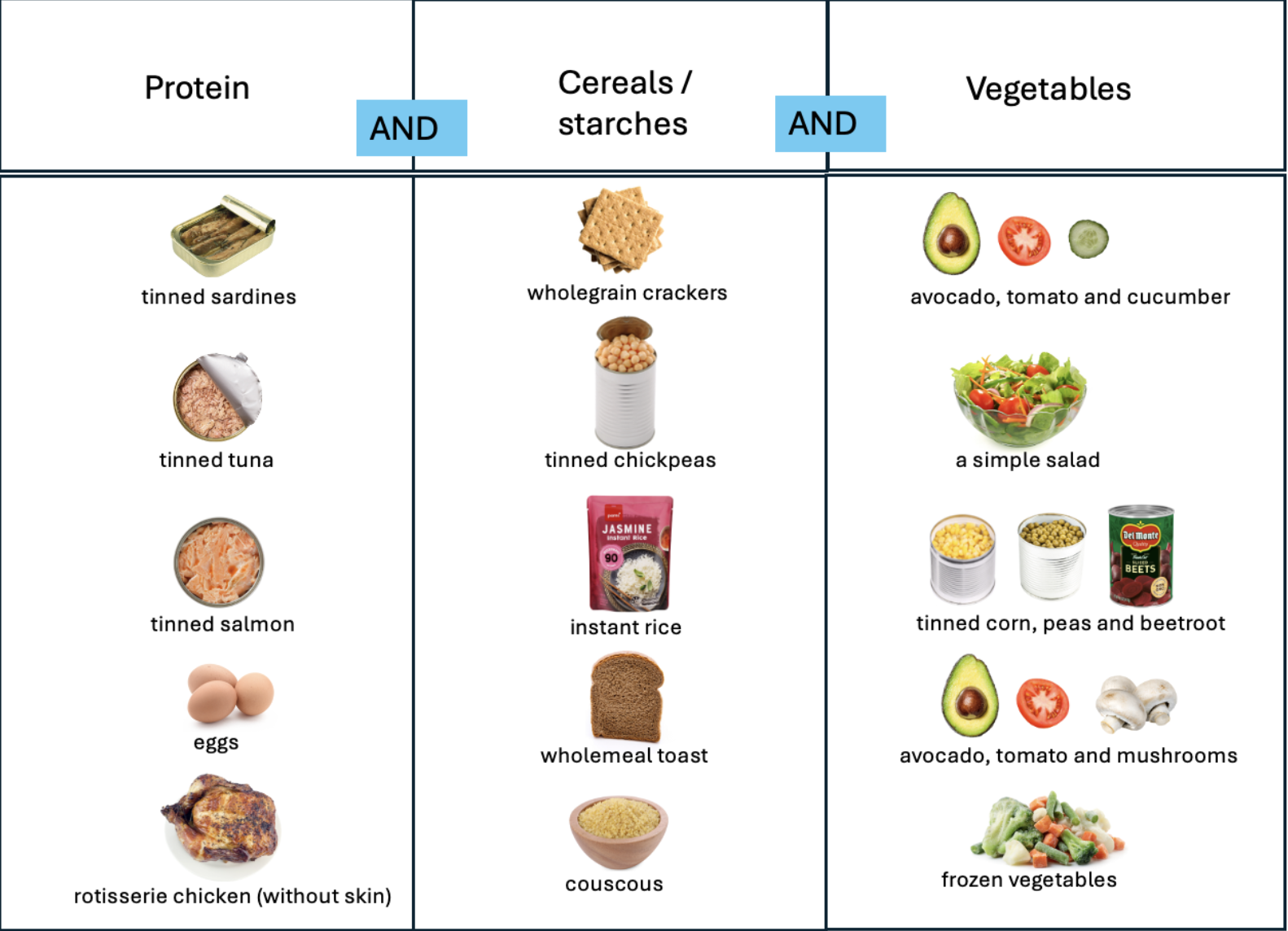
Adapted from Jacka et al, 2017
The dietary support group showed significantly greater improvement in depressive symptoms at 12 weeks. Participants' feedback revealed that the guidance from the nutrition professional was key. It helped them make lasting changes to their diet and, in turn, to their mental health. Factors, such as cost, time and lack of cooking skills may pose real barriers to adopting a healthy diet, so it may not be surprising that professional support played such an important role. This has led some researchers to question whether the results were driven by the dietary changes themselves or by the behavioural support provided alongside them. Either way, this finding is echoed in the wider research too: interventions delivered by a nutrition professional tend to achieve better outcomes than self-directed approaches.
A final thought
The evidence in this area is still developing and, overall, is regarded as low to moderate certainty. Diet should not be viewed as a replacement for medication or therapy, but rather as one potentially valuable piece of a larger picture. That said, the message is clear: making small, healthy choices consistently may be one of the most accessible investments in our long-term wellbeing.
References
Global,Regional,andNationalBurdenof12MentalDisordersin204Countriesand Territories, 1990–2019: A Systematic Analysis for The Global Burden of Disease Study 2019.The Lancet Psychiatry, 9, pp.137-150
AbukmailE.,PradeepN.K.,AhmedS.,AlbarqouniL.,2025. Moderate-toLong-Term Effect of Dietary Interventions for Depression and Anxiety: A Systematic Review and Meta-analysis.Annals of Internal Medicine, 178(7), pp. 987-999. doi: 10.7326/ANNALS-24-03016
WHO,2022. WorldMentalHealthReport:Transformingmentalhealthforall. Geneva.
LassaleC.,BattyG.D.,BaghdadliA.,JackaF.,Sánchez-VillegasA.,KivimäkiM., Akbaraly T., 2019. Healthy Dietary Indices and Risk of Depressive Outcomes: A Systematic Review and Meta-Analysis of Observational Studies.Molecular Psychiatry, 24(7):965-986. doi: 10.1038/s41380-018-0237-8
Bizzozero-PeroniB.,Díaz-GoñiV.,Fernández-RodríguezR.,Martínez-VizcaínoV., Jiménez-López E., Visier-Alfonso M.E., Garrido-Miguel M., Eumann Mesas A., 2025. Plant-Based Diets and Mental and Neurocognitive Health Outcomes: A Systematic Review with Meta-Analysis. Nutrition Reviews, 83(12), pp.2282–2295, https://doi.org/10.1093/nutrit/nuaf080
LaneM.M.,LotfalianyM.,HodgeA.M.,O'NeilA.,TravicaN,JackaFN,RocksT, Machado P, Forbes M, Ashtree DN, Marx W. High ultra-processed food consumption is associated with elevated psychological distress as an indicator of depression in adults from the Melbourne Collaborative Cohort Study. J Affect Disord. 2023 Aug 15;335:57-66. doi: 10.1016/j.jad.2023.04.124
MarxW.,LaneM.,HockeyM.,AslamH.,BerkM.,WalderK.,BorsiniA.,FirthJ., Pariante C.M., Berding K., Cryan J.F., Clarke G., Craig J.M., Su K.P., Mischoulon D., Gomez-Pinilla F., Foster J.A., Cani P.D., Thuret S., Staudacher H.M., Sánchez-Villegas A., Arshad H., Akbaraly T., O'Neil A., Segasby T., Jacka F.N., 2021. Diet and Depression: Exploring the Biological Mechanisms of Action.Molecular Psychiatry. 26(1), pp.134-150. doi: 10.1038/s41380-020-00925-x
ZhuZ.,ChengY.,LiuX.,XuX.,DingW.,LingZ.,LiuJ.,CaiG.,2025.TheMicrobiota- Gut-Brain Axis in Depression: Unravelling the Relationships and Therapeutic Opportunities. Frontiers in Immunology, 16, pp. 1644160. doi: 10.3389/fimmu.2025.1644160
O'NeillS.,MinehanM.,Knight-AgarwalC.R.,TurnerM.,2022.Depression,IsIt Treatable in Adults Utilising Dietary Interventions? A Systematic Review of Randomised Controlled Trials.Nutrients, 14(7), pp. 1398. doi: 10.3390/nu14071398
Bizzozero-Peroni B., Martínez-Vizcaíno V., Fernández-Rodríguez R., Jiménez-López E., Núñez de Arenas-Arroyo S., Saz-Lara A., Díaz-Goñi V., Mesas A.E., 2025. The Impact of the Mediterranean Diet on Alleviating Depressive Symptoms in Adults: A Systematic Review and Meta-Analysis of Randomized Controlled Trials.Nutrition
Reviews, 83(1):29-39. doi: 10.1093/nutrit/nuad176
Firth J., Marx W., Dash S., Carney R., Teasdale S.B., Solmi M., Stubbs B., Schuch F.B., Carvalho A.F., Jacka F., Sarris J., 2019. The Effects of Dietary Improvement on Symptoms of Depression and Anxiety: A Meta-Analysis of Randomized Controlled Trials. Psychosomatic Medicine, 81(3), pp. 265-280. doi: 10.1097/PSY.0000000000000673
Jacka F.N., O'Neil A., Opie R., Itsiopoulos C., Cotton S., Mohebbi M., Castle D., Dash S., Mihalopoulos C., Chatterton M.L., Brazionis L., Dean O.M., Hodge A.M., Berk M., 2017. A Randomised Controlled Trial of Dietary Improvement for Adults with Major Depression (the 'SMILES' trial).BMC Medicine, 15(1):23. doi: 10.1186/s12916-017- 0791-y. Erratum in: BMC Medicine. 2018 Dec 28;16(1):236. doi: 10.1186/s12916- 018-1220-6
